

07 May Bathroom Waterproofing Singapore: The Ultimate 2026 Homeowner’s Guide
Could a single hairline crack in your master toilet floor lead to a S$2,000 repair bill and a heated dispute with the neighbor living below you? For many Singaporean homeowners, the sudden appearance of water stains on a ceiling isn’t just a maintenance issue; it’s a source of genuine anxiety regarding hidden costs and the chaos of hacking repairs. We understand that maintaining your home’s structural integrity is a serious responsibility. Effective bathroom waterproofing in 2026 requires a diagnostic-first approach that balances advanced technology with strict regulatory compliance.
You deserve clarity on your legal obligations and a permanent solution that stops leaks without unnecessary disruption. This guide provides essential insights into the latest HDB regulations updated in February 2026, including mandatory water ponding tests and the 3-year BTO tile restriction. You’ll learn how to identify failures early, evaluate non-invasive chemical infusion methods, and secure a reliable, BCA-compliant service that offers a long-term warranty and total peace of mind.
Key Takeaways
- Learn to differentiate between internal seepage and inter-floor leaks to determine your legal and financial responsibilities under HDB guidelines.
- Understand the latest 2026 HDB regulations, including the mandatory water ponding test and the three-year tile replacement restriction for BTO flats.
- Evaluate the benefits of modern, non-invasive technology versus traditional hacking to choose the most efficient bathroom waterproofing method for your budget.
- Follow a professional step-by-step action plan to manage sudden leaks, including neighbor communication and the use of precision moisture meter diagnostics.
- Identify the critical certifications, such as BCA accreditation and HDB licensing, that ensure your contractor provides a reliable, long-term warranty.
Identifying Bathroom Leakage: Signs and Symptoms in Singapore Homes
Recognizing the early indicators of a leak is the first step in preventing long-term structural damage. In Singapore’s humid climate, moisture often travels through porous concrete before it becomes a visible flood. Professional Waterproofing is not just about stopping water; it’s about preserving the integrity of your property. Homeowners often mistake minor condensation for a leak, but persistent dampness usually signals a failure in the bathroom waterproofing membrane. When this protective barrier degrades, water seeps into the floor slab, eventually affecting the unit directly below you.
Visual cues provide the most immediate evidence of a problem. You might notice yellowish or brownish stains spreading across a ceiling. These are often accompanied by peeling paint or efflorescence, which is a white, powdery salt deposit that forms when water reacts with the minerals in concrete. If you ignore these signs, the moisture can lead to toxic mold growth or even corrode the steel reinforcement bars within the floor slab. This corrosion causes the concrete to crack further, accelerating the rate of the leak.
Hidden leaks are more deceptive and require a disciplined eye. Water can track along pipes or settle under floor traps without showing on the surface immediately. We recommend tapping on your bathroom tiles; a hollow clacking sound suggests debonding, which often occurs when water has compromised the adhesive layer beneath. This is a critical indicator that the underlying bathroom waterproofing system requires professional intervention. Detecting these issues early can save you from the high costs of a total bathroom overhaul.
Common Signs of Bathroom and Toilet Leaks
- Persistent damp patches or discoloration on the ceiling of the unit below.
- Musty odors that linger even after thorough cleaning, often concentrated near floor traps or corners.
- Hollow sounds when tapping on floor tiles, indicating that the tile has separated from the screed.
- Visible mold or mildew growth in grout lines that reappears quickly after scrubbing.
HDB Ceiling Leaks: The 50/50 Cost-Sharing Rule
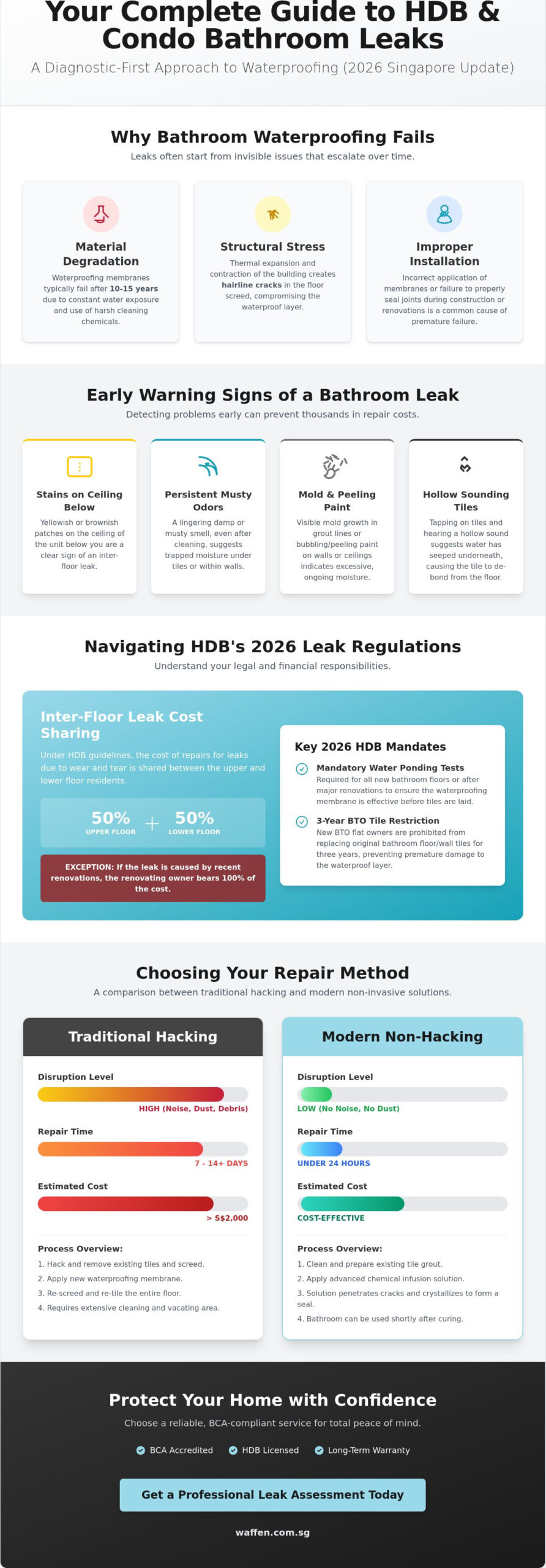
When a leak affects the ceiling of the flat below, HDB’s inter-floor leak protocol generally applies. Under these regulations, the responsibility for repairs is shared equally between the upper-floor and lower-floor owners. This 50/50 cost-sharing rule assumes the leak is caused by natural wear and tear over time. However, HDB guidelines updated in February 2026 clarify that if the leak is caused by recent renovations, the owner who carried out the work is liable for the full repair cost. Understanding who is responsible for an hdb ceiling leak is vital for maintaining neighborly relations and meeting legal timelines. If both parties cannot agree, HDB may step in to mediate or take enforcement action to ensure the building’s structural safety.
Why Bathroom Waterproofing Fails: The Science of Structural Seepage
Waterproofing failure is defined as the point when a protective membrane or sealant loses its integrity, allowing moisture to bypass the intended barrier. In the context of bathroom waterproofing, this isn’t just a surface issue; it’s a structural threat. Singapore’s relentless humidity, which frequently stays above 80 percent, creates a challenging environment for building materials. This moisture remains trapped within the porous concrete, slowly weakening the chemical bonds of traditional sealants and membranes over time.
Building movement also plays a significant role in failure. Despite their solid appearance, HDB blocks and private apartments are subject to constant thermal expansion. As temperatures fluctuate throughout the day, the concrete expands and contracts. This cycle creates hairline cracks in the floor screed. If the original bathroom waterproofing system lacks the elasticity to bridge these gaps, water will inevitably find a path to the slab below. This process is often silent and invisible until the damage reaches the ceiling of the unit downstairs.
Deterioration of Waterproofing Membranes
Liquid-applied membranes are standard in many residential projects, yet they typically fail after 10 to 15 years of continuous use. This lifespan is often shortened by the use of harsh, acidic cleaning chemicals. These agents strip away the protective qualities of the grout and attack the membrane directly. Hydrostatic pressure refers to the force exerted by standing water that pushes moisture through the microscopic pores and cracks of a concrete slab. Once this pressure overcomes the aging membrane, the leak becomes active and persistent.
Structural Risks: From Leaks to Spalling Concrete
When water penetrates the concrete slab, it eventually reaches the internal steel reinforcement bars. The resulting oxidation causes the rebar to rust and expand. This expansion exerts immense internal pressure, eventually forcing the concrete to crack and flake off. This dangerous condition is a primary reason homeowners seek spalling concrete repair singapore. What starts as a minor damp patch can quickly escalate into a structural emergency. If you notice early signs of seepage, consulting a waterproofing specialist for a diagnostic inspection is the most cost-effective way to prevent high-priced structural repairs.
Comparing Repair Methods: Hacking vs. Non-Hacking Technology
Choosing the correct repair method depends on the severity of the seepage and the structural condition of your bathroom. While traditional hacking provides a comprehensive reset, modern non-invasive technologies offer a faster, cleaner alternative for busy homeowners. A reliable bathroom waterproofing strategy often involves a combination of these techniques based on a professional diagnostic report that identifies the specific path of water ingress.
Traditional Hacking and Waterproofing Overhaul
Traditional hacking involves removing existing floor tiles and the underlying cement screed to expose the bare concrete slab. This process allows a specialist to apply a new, high-performance waterproofing membrane directly to the structure. While this method offers the longest lifespan, it is the most disruptive and costly option. Market rates in 2026 for a standard HDB bathroom overhaul typically range from S$800 to S$2,000. This intensive approach is often necessary for severe structural issues or when addressing complex roof waterproofing and balcony leaks where the original barrier has completely disintegrated. Under HDB regulations updated in January 2026, any renovation involving tile hacking must be performed by an HDB-registered contractor to ensure compliance with safety standards.
PU Injection Grouting: The No-Hacking Specialist Choice
PU Injection Grouting is a surgical, non-invasive method designed to stop active ceiling leaks from the unit below. A technician injects a specialized polyurethane resin into the concrete slab through pre-drilled ports. Once inside, the resin reacts with moisture and expands rapidly to fill voids, cracks, and honeycombed concrete. This method is highly efficient, often stopping a persistent leak in as little as 2 to 4 hours. It is the preferred choice for homeowners who want to avoid the dust, noise, and high labor costs associated with hacking. This technique is particularly effective for sealing cracks caused by the thermal expansion and building movement discussed in previous sections.
Flood Infusion and Clear Penetrative Treatment (CPT)
Flood infusion and Clear Penetrative Treatment (CPT) are surface-level solutions that do not require tile removal. These methods use chemical sealants that penetrate deep into the tile grout lines and the pores of the concrete to create a hydrophobic moisture barrier. CPT is an excellent preventative measure for bathrooms showing early signs of surface seepage or dampness. However, these chemical infusions have limitations. They are less effective on older, heavily damaged slabs where structural cracks are too wide for the sealant to bridge. For a permanent bathroom waterproofing solution in aging properties, we often recommend a diagnostic moisture test to determine if a surface treatment is sufficient or if structural grouting is required.
How to Manage a Bathroom Leak: A Step-by-Step Action Plan
When a leak occurs, panic is often the first reaction. However, a disciplined approach minimizes structural damage and avoids legal friction with neighbors. The first step is immediate damage control. Turn off the main water supply if the leak is severe. Document the dampness with clear photos immediately. If you live in an HDB flat, communicate with your neighbor below as soon as possible. Open communication helps manage expectations and facilitates the 50/50 cost-sharing process mentioned in our earlier discussion on legal responsibilities.
Following damage control, you must engage a professional to diagnose the root cause. Relying on guesswork often leads to failed repairs and wasted money. Once you receive a quotation, check for transparency. A professional quote should clearly outline the materials used, such as polyurethane (PU) resin or cementitious coatings. After the repair is executed, monitor the area for at least 30 days. Look for any signs of returning moisture or musty odors. Maintaining clean floor traps and avoiding abrasive chemicals will extend the life of your new sealants.
Professional Diagnostic and Inspection
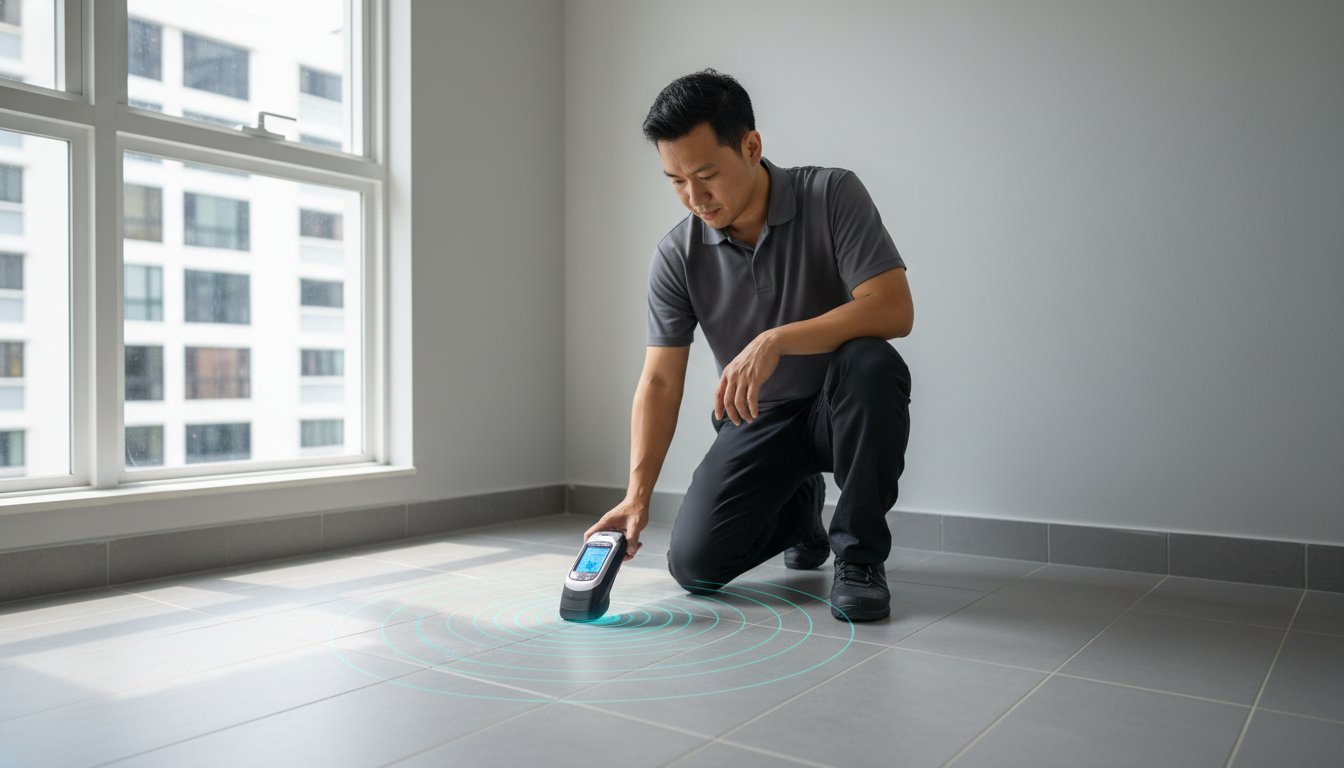
Waffen utilizes advanced thermal imaging and high-precision moisture detection technology to map the exact path of seepage. This non-invasive diagnostic identifies whether the issue stems from a pipe burst or a failed bathroom waterproofing membrane. Before hiring, verify that your contractor holds a BCA accreditation and an HDB license. These credentials ensure the work meets Singapore Standard SS 637:2018. If you’re facing an active leak, book a Same Day Free Onsite Inspection to protect your home’s structural integrity.
Ensuring Long-Term Results and Warranties
A successful repair must be validated by a water ponding test. This procedure involves sealing the floor traps and flooding the bathroom with approximately 25mm of water for 24 hours. A successful test confirms that the new bathroom waterproofing system is airtight and leak-free. Always demand a written warranty of at least 12 months. This guarantee reflects the contractor’s confidence in their workmanship and materials. Cheap repairs without warranties often cost more in the long run because they fail to address the root cause, leading to recurring seepage and secondary repair fees.
Professional Bathroom Waterproofing with Waffen: Reliability You Can Trust
Waffen Waterproofing has established itself as a premier waterproofing contractor through a decade of rigorous adherence to technical excellence. We operate with a sense of serious responsibility because we understand the stress that structural seepage causes property owners. Our identity as a Waterproofing Specialist is built on trust, credibility, and a safety-first mentality. We ensure that every technician is highly trained and compliant with BCA standards and HDB regulations. This disciplined approach has allowed us to successfully resolve thousands of bathroom and toilet leak issues across Singapore, from aging HDB blocks to luxury private estates.
Our company’s reputation is validated by our bizsafe certifications and our status as an HDB-licensed contractor. We don’t rely on marketing gimmicks; instead, we prioritize professional authority and precision in every task. Whether we’re performing wall crack injection or applying a high-performance torch-on membrane, our goal is to provide a reliable bathroom waterproofing solution that restores your peace of mind. Every project we undertake is a commitment to excellence, ensuring your home’s structural integrity remains uncompromised for years to come.
Transparent Pricing and Technical Expertise
We believe in a grounded and transparent approach to project management. Our project-based fees are clearly defined from the start, ensuring there are no hidden charges or unexpected costs during the repair process. By leveraging economies of scale, we provide affordable prices without sacrificing the quality of our materials. We utilize only high-quality membranes and specialized chemical sealants, such as polyurethane resins for pressure grouting, to ensure a permanent fix. This logical and methodical flow of service ensures that you receive the best technical expertise at a competitive market rate.
Book Your Free Onsite Inspection Today
Delaying a repair only increases the risk of spalling concrete and costly structural damage mentioned in previous sections. Our rapid response team is equipped to handle emergency leaks with the same level of discipline and efficiency found in our scheduled projects. If you require professional toilet waterproofing singapore, our experts are ready to provide a diagnostic-first assessment. We offer a Same Day Free Onsite Inspection to help you identify the root cause of your seepage immediately. Don’t let a minor leak become a major dispute. Contact Waffen Waterproofing for a Reliable Solution and secure your 12-month warranty today.
Secure Your Home’s Structural Integrity Today
Maintaining a leak-free home in Singapore is a matter of technical precision and regulatory compliance. We’ve explored how early detection using advanced moisture detection technology can prevent the progression to dangerous spalling concrete. You now understand the critical differences between non-invasive PU injection and traditional hacking overhauls. Most importantly, you’re equipped to navigate HDB’s 2026 guidelines regarding inter-floor leak responsibilities and mandatory water ponding tests.
Effective bathroom waterproofing is not a DIY task; it requires a partner who understands the high-stakes nature of structural seepage. Waffen Waterproofing operates as a BCA Accredited and HDB Licensed Contractor, providing you with the security of a 12 Months Warranty on all repairs. Our disciplined approach ensures we address the root cause, not just the visible symptoms, using the latest diagnostic tools available in the industry.
Take the first step toward a permanent, reliable solution for your property. Get a Free Same-Day Onsite Inspection from Waffen Waterproofing to protect your investment and maintain neighborly harmony. Rest assured that your home is in the hands of disciplined masters of the trade who value technical excellence above all else.
Frequently Asked Questions
How much does bathroom waterproofing cost in Singapore?
The average cost to waterproof a standard HDB bathroom in 2026 ranges from S$800 to S$2,000. For an average-sized area of 4 to 6 square meters, homeowners typically pay between S$800 and S$1,500. If you prefer a per-square-foot calculation, market rates currently sit between S$12 and S$30, depending on whether you choose cementitious coatings or advanced membrane systems.
Can I fix a bathroom leak without removing the tiles?
Yes, you can resolve most seepage issues using non-invasive technology such as PU injection grouting or chemical flood infusion. These methods target the structural cracks or porous grout lines directly, eliminating the need for a full overhaul. It’s a highly effective way to maintain bathroom waterproofing integrity without the dust and noise of traditional hacking. For those who eventually opt for a complete transformation, WDC Services offers a benchmark for high-quality bathroom and laundry renovations.
How long does a typical no-hacking bathroom repair take?
A professional no-hacking repair, such as PU injection, usually takes between 2 and 4 hours to complete. This is significantly faster than traditional methods that require several days of tile removal and drying time. Because the resin reacts and expands almost instantly, the leak often stops before our technicians leave your property.
Is the upper-floor neighbor always responsible for a ceiling leak in HDB flats?
No, responsibility is generally shared equally between the upper and lower-floor owners under the 50/50 cost-sharing rule. This applies to leaks caused by natural wear and tear of the structure. However, HDB guidelines updated in February 2026 state that if the leak resulted from recent renovations, the owner who performed the work must bear the full repair cost.
What is the difference between PU injection and flood infusion?
PU injection involves injecting expanding polyurethane resin into the concrete slab from the ceiling below to seal structural cracks. Flood infusion is a surface-level treatment where a chemical sealant is poured over the floor to penetrate grout lines and nano-cracks. While both are effective, PU injection is the preferred choice for stopping active, heavy inter-floor leaks.
How long will the waterproofing repair last?
A comprehensive hacking overhaul typically lasts between 10 and 15 years before the membrane begins to degrade naturally. Non-hacking repairs like PU injection provide long-term structural seals, but surface-level chemical treatments may require re-application every 3 to 5 years. Regular maintenance and avoiding acidic cleaners will help extend the lifespan of any repair.
Does HDB provide any grants for bathroom waterproofing or spalling concrete?
HDB offers the Home Improvement Programme (HIP) for eligible older blocks, which includes subsidized bathroom waterproofing as an essential repair. For urgent issues like spalling concrete, homeowners may apply for the Goodwill Repair Assistance (GRA) scheme. Under this scheme, HDB often co-pays a portion of the repair costs, provided the flat is not under the 3-year BTO warranty period.
What should I do if my neighbor refuses to cooperate with a leak repair?
You should first contact your Town Council or HDB Branch for mediation services to resolve the dispute amicably. If the neighbor remains uncooperative, HDB has the legal authority to enter the flat and carry out necessary repairs under the Housing and Development (Penalties) Rules. This ensures that structural damage, such as rebar corrosion, doesn’t compromise the safety of the entire building block.

Sorry, the comment form is closed at this time.