

22 Apr Professional Roof Waterproofing in Singapore: The 2026 Master Guide
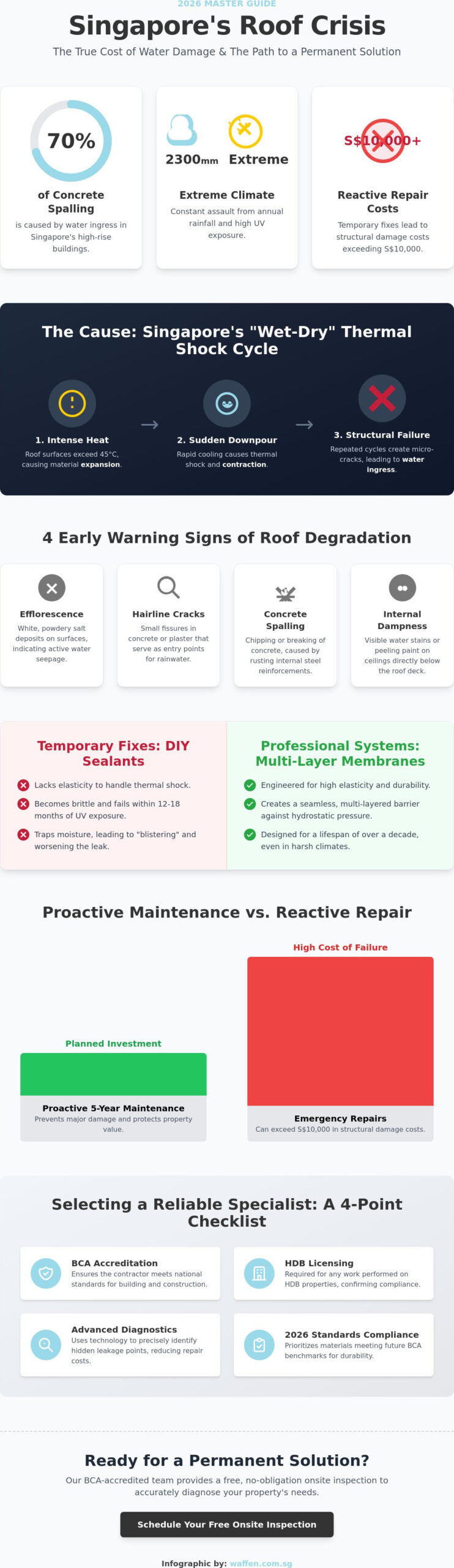
Did you know that water ingress is responsible for nearly 70% of concrete spalling cases in Singapore high-rise buildings? You’ve likely experienced the frustration of a “repaired” leak that returns the moment a monsoon surge hits. These recurring issues aren’t just annoying; they’re a sign that your current roof waterproofing isn’t standing up to our local climate’s 2,300mm of annual rainfall. Relying on temporary fixes often leads to structural damage costs that can quickly exceed S$10,000 for a typical residential unit.
We agree that your home or commercial asset deserves a reliable solution that lasts longer than a single season. As a professional Waterproofing Specialist, we’ve developed this 2026 master guide to help you master the technical essentials of structural protection. You’ll gain a clear understanding of the ROI behind professional-grade systems and how to remain compliant with BCA and HDB regulations. We’ll examine high-performance membrane types, such as torch-on and liquid-applied systems, providing a clear roadmap to keep your property permanently dry and secure.
Key Takeaways
- Understand how multi-layered barrier systems defend against hydrostatic pressure and Singapore’s extreme UV exposure to prevent long-term structural damage.
- Evaluate the latest 2026 standards for roof waterproofing technologies to ensure your flat or pitched roof remains durable under intense monsoon conditions.
- Learn how advanced diagnostic technology identifies hidden leakage points with precision, reducing repair costs by targeting only the affected areas.
- Discover the financial advantages of a proactive 5-year maintenance cycle compared to the high cost of emergency repairs and its impact on property valuation.
- Identify the essential regulatory credentials, including BCA accreditation and HDB licensing, required to select a reliable specialist for your property.
Understanding Roof Waterproofing in Singapore’s Tropical Climate
In the construction industry, professional roof waterproofing is defined as the application of a multi-layered barrier system designed to resist hydrostatic pressure. This system protects the building envelope from water ingress, ensuring the structure remains dry and stable. In Singapore, this protection is critical because our buildings face some of the harshest environmental stressors globally. With an average annual rainfall exceeding 2,100mm and a UV index that frequently reaches extreme levels, a standard roof deck is under constant physical assault.
The primary driver of roof failure in Singapore is the intense “wet-dry” cycle. During the day, concrete roofs absorb heat, reaching surface temperatures above 45°C. When a sudden monsoon downpour occurs, the temperature drops rapidly; this causes immediate thermal shock. This cycle leads to significant thermal expansion and contraction, which eventually manifests as structural cracks. Without a high-performance Waterproofing solution, these cracks allow moisture to penetrate the slab, compromising the structural integrity of the entire building. As a BCA accredited specialist, we’ve seen how these micro-fissures lead to long-term reinforcement bar corrosion if left untreated.
Why Conventional Sealants Often Fail
Many property owners initially opt for superficial DIY coatings or hardware-store sealants to address leaks. These quick-fix solutions fail because they lack the elongation properties required to withstand Singapore’s high humidity and heat. Professional-grade membranes are engineered for elasticity, whereas basic sealants become brittle within 12 to 18 months of UV exposure. Using inferior materials often leads to trapped moisture beneath the layer. This causes “blistering,” where water vapor expands under the sun, eventually rupturing the coating and worsening the original leak.
Signs of Roof Degradation You Should Not Ignore
Early detection prevents costly structural repairs. You should regularly inspect your roof for damp spots, hairline cracks, and signs of salt migration. A key indicator of advanced moisture penetration is efflorescence. Identifying these signs early allows for targeted interventions like pressure grouting or wall crack injection before the damage necessitates a full roof replacement. Our team provides a same day free onsite inspection to help property owners identify these risks accurately.
- Efflorescence: This is the migration of soluble salts to the surface of concrete, appearing as white, powdery deposits that indicate active water seepage through the substrate.
- Hairline Cracks: Small fissures that serve as entry points for rainwater and carbonation.
- Concrete Spalling: The breaking or chipping of concrete caused by the rusting and expansion of internal steel reinforcements.
- Internal Dampness: Visible water stains on the ceiling directly below the roof deck.
Maintaining the building envelope requires a disciplined approach to maintenance. We’ve helped over 1,000 clients across Singapore secure their properties by moving beyond temporary patches to reliable, long-term membrane systems. Ignoring minor seepage today can lead to structural instability tomorrow, especially in high-density HDB and private residential blocks where water can travel through shared slabs.
Core Waterproofing Technologies: Choosing the Right System
Selecting a roof waterproofing system requires a disciplined assessment of the structure’s geometry and substrate material. For flat concrete roofs common in Singapore’s HDB blocks and commercial hubs, durability depends on the system’s ability to withstand ponding water. Pitched roofs using metal sheets or clay tiles require high-adhesion coatings that don’t peel under extreme thermal expansion. By 2026, Singapore’s updated climate standards will mandate higher solar reflectance for all exposed membranes to combat the urban heat island effect. Professional contractors now prioritize materials that meet these BCA-aligned benchmarks. Different substrates like weathered concrete or galvanized steel require specific primers to ensure the chemical bond remains intact for over a decade.
Torch-on Bituminous Membranes
This system involves heat-welding layers of bitumen-saturated felt onto the roof surface. The process creates a thick, multi-layer barrier with exceptional seam strength. It’s the standard for large, flat concrete decks where heavy-duty protection is mandatory. A typical 4mm bituminous membrane offers a service life of 12 to 15 years. We ensure every lap joint is fused to prevent capillary action, following industry best practices for high-traffic commercial rooftops. These systems are favored for their puncture resistance and ability to handle the weight of MEP equipment.
Liquid-Applied Polyurethane (PU) Coatings
Liquid PU is a versatile choice for roofs with complex shapes, air-conditioning ledges, or solar panel mounts. It cures into a monolithic, seamless membrane that leaves no room for joint failure. For exposed rooftops, we use UV-stable aliphatic PU coatings. These reflect up to 85% of solar radiation, preventing the substrate from cracking due to heat stress. This technology is essential for intricate geometries where traditional sheets can’t provide a tight seal. Because it’s cold-applied, it’s also a safer alternative in fire-sensitive environments.
PU Injection Grouting for Active Leaks
When a leak appears inside a high-rise unit, external roof waterproofing replacement isn’t always the first step. PU injection grouting is a “no-hacking” solution that addresses the problem from the inside. A technician injects hydrophobic polyurethane resin into the concrete at high pressure. The resin expands up to 10 times its volume upon contact with moisture, sealing micro-cracks permanently. It’s a fast, BCA-approved method that minimizes disruption for residents. If you notice damp spots on your ceiling, a reliable inspection can determine if grouting is the right fix for your property.
- Durability: Bituminous systems excel in heavy-duty commercial use.
- Versatility: Liquid PU handles complex protrusions and equipment mounts.
- Efficiency: Injection grouting stops active leaks without structural demolition.
The Diagnostic Process: Advanced Leak Detection Technology
Traditional visual inspections often fail because water rarely enters a structure at the exact point where a stain appears. Gravity and capillary action pull moisture through microscopic fissures in concrete, making the actual source invisible to the naked eye. Waffen Waterproofing Pte Ltd replaces guesswork with scientific precision through our Same Day Free Onsite Inspection. By identifying the exact origin of a leak, we eliminate the costly trial and error cycle that plagues many Singaporean property owners. Our technicians don’t just look for leaks; they map the entire moisture profile of your roof.
Modern diagnostics allow us to target only the compromised sections of a structure. This data-driven strategy significantly reduces repair costs compared to full-scale roof replacements. Our methodology aligns with the BCA Design for Maintainability Guide, which emphasizes the importance of accurate defect identification to ensure long-term structural integrity. As a BCA accredited specialist, we prioritize non-invasive methods to protect your asset. This disciplined approach ensures that every roof waterproofing solution we provide is both effective and economical.
Infrared Thermal Imaging
Thermography uses high-resolution infrared cameras to visualize temperature variations across a roof surface. Since damp materials retain heat differently than dry ones, these temperature differentials reveal hidden moisture pockets behind walls and under floor tiles. This technology allows our technicians to trace the path of water ingress without destructive testing. Thermal imaging saves homeowners from unnecessary hacking and the associated S$2,000 to S$5,000 in restoration costs by pinpointing the specific failure point in the roof waterproofing system.
Electronic Moisture Meters and Ultrasound
Precision is vital when dealing with reinforced concrete slabs common in HDB and private developments. We use electronic moisture meters to measure the exact percentage of water saturation within a substrate. This data determines if a surface is dry enough for a new torch-on membrane or liquid-applied coating. Additionally, ultrasonic sensors detect voids or delamination within the waterproofing layer that are otherwise undetectable. Every inspection concludes with a comprehensive diagnostic report. This document provides a clear roadmap for the repair, ensuring every client understands the technical requirements before work begins. Our commitment to being a Reliable Waterproofing Specialist means providing you with facts, not estimates.
Proactive Maintenance vs. Reactive Repair: A Cost-Benefit Analysis
Choosing between proactive maintenance and reactive repair is often the difference between a manageable service fee and a structural overhaul costing tens of thousands of dollars. A standard 5-year maintenance cycle for roof waterproofing involves routine inspections and localized touch-ups. This prevents hairline cracks from evolving into major failures. In contrast, emergency structural repairs triggered by long-term neglect often require full membrane replacement and masonry work. These reactive measures can cost up to 400% more than a scheduled maintenance plan over a 10-year period.
Water seepage significantly impacts property valuation in the Singapore real estate market. Potential buyers and bank valuers often penalize properties with visible water marks or a documented history of leaks. A property with unresolved seepage issues can see a 5% to 8% reduction in its market value during a valuation. Beyond aesthetics, the hidden costs of leaks are dangerous. Professional mold remediation can cost between S$1,200 and S$5,500 depending on the severity of the spread. Electrical hazards pose an even greater risk, as water infiltrating conduits can lead to short circuits or localized fires.
Property owners often ask why they should pay for roof waterproofing if no leaks are currently visible. The answer lies in the nature of reinforced concrete. By the time a damp patch appears on your ceiling, the internal rebar has likely already begun to oxidize and expand. Proactive treatment stops water before it reaches the structural steel. It’s an investment in the building’s skeleton, not just a cosmetic fix. If you’re currently dealing with an active leak, consulting roof leakage repairs specialist contractors can help you understand which permanent solution best fits your property type and budget.
The Lifecycle of a Waterproofing System
Typical waterproofing membranes in Singapore’s harsh tropical climate have a lifespan of 10 to 15 years. High UV exposure and intense monsoon rainfall accelerate chemical degradation. Ponding water is a primary enemy of system longevity. If water remains on a flat roof for more than 48 hours, it softens the membrane and weakens the bond. Regular clearing of gutters and drainage outlets ensures water flows off the roof quickly, which can extend the system’s life by 25%; for those who harvest this runoff, professional analysis from awarewatertesting.com.au can ensure the water is safe for its intended use.
Insurance and Liability in Singapore
Understanding liability is crucial for HDB and private condo owners. Under the Housing and Development (Renovation) Regulations, flat owners are generally responsible for maintaining their floor slabs. In private estates, the Building Maintenance and Strata Management Act (BMSMA) dictates that inter-floor leakage costs are often shared between upper and lower units. For HDB residents navigating the complexities of HDB ceiling leak responsibilities and repair obligations, understanding the Goodwill Repair Assistance framework is essential before filing any claims. Using a BCA-accredited contractor and maintaining professional certification of works is vital for successful insurance claims. This documentation proves you’ve exercised due diligence in property upkeep, making it easier to settle disputes with neighbors or insurers.
Don’t wait for a ceiling leak to compromise your property’s structural integrity. Contact a Reliable Waterproofing Specialist for a professional onsite inspection today.
Selecting a Specialist Roof Waterproofing Contractor
Choosing a contractor for your property isn’t just about comparing the lowest quotes. In Singapore, property owners must verify that a firm holds Building and Construction Authority (BCA) accreditation and a Housing & Development Board (HDB) license. These credentials aren’t optional. They serve as a guarantee that the company adheres to strict structural safety standards and legal requirements. Without these, you risk poor workmanship that could compromise your building’s integrity and lead to expensive rectifications later.
Ensuring you have the right team for structural work is vital. Similarly, for other home improvement needs, you can check out Direct Renovation Contractor Singapore to work directly with experienced contractors and avoid unnecessary middleman fees.
Safety is another critical pillar. A bizsafe certification is vital for onsite safety and liability protection. This certification proves the contractor maintains a rigorous risk management system to protect both the workers and your property. It ensures that every roof waterproofing project is executed with discipline, reducing the likelihood of accidents that could result in legal complications for the property owner.
You should also scrutinize the details of any guarantee. A standard 12-month warranty must cover more than just the surface. It should encompass both the material performance and the labor quality. If a leak recurs within this period, a reliable specialist will return to rectify the issue at no additional cost. This reflects a commitment to technical durability and provides the peace of mind you need when investing in structural maintenance.
Questions to Ask Your Contractor Before Signing
Professionalism is found in the details. Before you sign any contract, ask the following questions to gauge the contractor’s expertise:
- Which brands of membranes and resins do you use? High-quality materials from established manufacturers are essential to withstand Singapore’s intense UV radiation and heavy rainfall.
- What does your “Same Day Free Onsite Inspection” include? A thorough inspection should involve moisture meter testing or thermal imaging rather than a simple visual check.
- Are your technicians certified for rope access? For high-rise external wall work, technicians must hold valid IRATA or equivalent certifications to ensure they can work safely at heights.
The Waffen Waterproofing Commitment
Waffen operates with a “Safety First” mentality. We don’t just hire workers; we develop specialists through rigorous technician training programs that focus on precision and compliance. Our team understands that roof waterproofing is a technical craft that requires constant updates on the latest resin injection and membrane application methods. We combine this technical mastery with transparent pricing, ensuring you receive a premium service without hidden fees.
Our track record speaks for itself. We recently completed a comprehensive roof restoration for a 45,000 square foot commercial complex in the Jurong industrial sector. The project involved complex torch-on membrane application and was completed 72 hours ahead of the projected deadline with zero safety incidents. This level of efficiency and reliability is what we bring to every job site across Singapore.
Don’t wait for a minor leak to become a major structural failure. Schedule your free onsite inspection with Waffen today and secure your property with the help of a certified specialist.
Future-Proof Your Asset with Advanced Protection Standards
Securing your property against Singapore’s intense tropical rainfall requires more than a quick fix. It demands a systematic approach to roof waterproofing that prioritizes long-term durability over temporary patches. By 2026, the shift toward proactive maintenance and advanced diagnostic technology has become the industry standard for effective asset protection. Utilizing thermal imaging ensures that hidden moisture pockets are identified before they escalate into expensive structural failures. This technical precision, combined with high-performance membrane systems, provides the security your home or commercial building deserves.
Waffen Waterproofing delivers this peace of mind through disciplined technical excellence. As a BCA Accredited and HDB Licensed specialist, we provide a 12-month warranty on all repairs to guarantee your investment remains dry. Our team uses advanced thermal imaging tech to pinpoint issues with surgical accuracy. This ensures every project meets the highest regional safety standards and building regulations. Don’t let a minor leak become a major liability for your property. You can rely on our expertise to keep your structure sound for years to come.
Book Your Free Same-Day Onsite Inspection with Waffen Waterproofing
Frequently Asked Questions
How much does roof waterproofing cost in Singapore in 2026?
Roof waterproofing costs in Singapore for 2026 typically range from S$15 to S$60 per square metre depending on the chosen material and roof complexity. For a standard landed property with a 1,500 square foot roof area, owners should budget between S$4,000 and S$15,000 for a professional grade application. These figures align with recent Building and Construction Authority (BCA) price indices for construction materials and local labor market rates.
How long does a typical roof waterproofing project take to complete?
A standard residential roof waterproofing project usually takes 3 to 7 working days to finish under clear weather conditions. Small scale repairs or localized PU injection grouting can be completed within 24 to 48 hours. Larger commercial projects or those requiring multi-layered torch-on membranes might extend to 14 days. Our team prioritizes a strict schedule to ensure your property’s structural integrity is restored with minimal downtime.
Can I waterproof my roof without hacking the existing tiles?
You can effectively waterproof your roof without hacking by using advanced liquid-applied membranes or transparent penetrative sealers. These non-destructive methods involve applying a high-performance coating directly over existing tiles or substrate. This approach reduces labor costs by 25% and eliminates the noise and dust associated with traditional hacking. As a reliable waterproofing specialist, we recommend this for homeowners seeking a fast, mess-free solution.
What is the difference between a roof repair and a full waterproofing system?
A roof repair focuses on fixing visible cracks or localized leaks in a specific area, whereas a full waterproofing system covers the entire roof surface to provide comprehensive protection. Repairs are reactive and solve immediate problems, but they don’t prevent new leaks from forming elsewhere. A full system creates a 100% seamless barrier across the whole structure. This holistic approach is more cost-effective over a 10-year period because it includes an extended warranty.
Is PU injection grouting a permanent solution for roof leaks?
PU injection grouting is an excellent solution for stopping active water ingress through concrete cracks, but it’s most effective when used as part of a dual-layer defense. The polyurethane resin expands upon contact with moisture to seal voids within the slab. While it provides immediate relief, we often combine it with an external membrane for long-term durability. This method is a staple for roof leakage repairs specialist contractors dealing with internal ceiling leaks where external access is limited.
Does HDB provide any subsidies for roof leak repairs?
HDB offers the Goodwill Repair Assistance (GRA) scheme which covers 50% of the repair cost for ceiling leaks between floor units. The remaining 50% is typically shared equally between the upper and lower floor flat owners. If you live on the highest floor and the leak originates from the main roof, the Town Council is responsible for the full repair cost. These regulations fall under the Building Maintenance and Strata Management Act (BMSMA) which governs common property maintenance. For a detailed breakdown of how the GRA scheme works and your rights as a flat owner, our 2026 guide to HDB ceiling leak causes, responsibilities, and repairs covers the full process step by step.
How often should I have my roof inspected for potential leaks?
You should schedule a professional roof inspection at least once every 12 months to identify wear and tear before it becomes a major failure. Singapore’s intense UV radiation and heavy tropical rainfall can degrade roofing materials 20% faster than in other climates. Regular maintenance checks help extend the lifespan of your roof waterproofing system by several years. We provide a Same Day Free Onsite Inspection to give property owners immediate clarity on their roof’s condition.
What should I do immediately if I notice a water stain on my ceiling?
Clear all furniture from the affected area and take clear photographs of the stain to document the damage for insurance or Town Council claims. Place a container to catch any active drips and mark the edges of the stain with a pencil to see if it expands during the next rainstorm. Contact a BCA accredited specialist immediately to perform a professional assessment. Quick action prevents mold growth, which can start within 48 hours of water exposure.

Sorry, the comment form is closed at this time.