


23 Aug How Much Does Roof Waterproofing Cost in Singapore?
Short answer: Roof waterproofing in Singapore typically costs around S$15 to S$60 per square metre for professional waterproofing works, depending on the waterproofing system, roof condition, surface preparation and accessibility.
For a typical landed property, the total project can range from several thousand dollars to S$15,000 or more when extensive repairs, membrane replacement or difficult access are involved.
Introduction
Roof waterproofing is an important part of maintaining a property in Singapore, where heavy rainfall, high humidity and year-round exposure to heat can place significant stress on roof surfaces.
However, there is no single fixed price for roof waterproofing. Two roofs of the same size can have very different costs because one may only require a new waterproofing coating, while another may need crack repairs, removal of an existing membrane, drainage corrections or other preparation work before waterproofing can begin.
For this reason, it is better to look at roof waterproofing costs as a range rather than relying on one average price per square metre.
Average Roof Waterproofing Cost in Singapore
As a general 2026 guide, professional roof waterproofing in Singapore can cost approximately S$15–S$60 per square metre, depending on the system and complexity of the project.
For a landed property, the overall cost may be considerably higher than a simple per-square-metre calculation because contractors may also need to account for preparation, repairs, access, detailing and testing.
| Type of Roof Waterproofing Work | Indicative Cost |
|---|---|
| Basic liquid waterproofing | S$15–S$30/m² |
| Higher-performance liquid membrane system | S$25–S$60/m² |
| Torch-on or bituminous membrane system | S$30–S$60+/m² |
| Localised roof leak repair | From around S$300–S$500 |
| Full roof waterproofing for a landed property | Approximately S$4,000–S$15,000+ |
| Extensive roof remediation or membrane replacement | S$15,000+ depending on scope |
These figures are indicative only. Actual prices vary according to the roof’s condition, size, waterproofing method, accessibility and amount of preparation required.
Why Roof Waterproofing Prices Vary
The waterproofing material itself is only one part of the overall cost. Much of the difference between quotations comes from what needs to happen before and around the waterproofing system.
Roof Size
A larger roof generally requires more materials and labour. However, price does not always increase in a simple linear way because larger projects may also involve more joints, drains, penetrations, parapet walls and difficult areas.
For example, a small localised repair is not necessarily economical on a per-square-metre basis because the contractor still has to inspect the area, prepare the surface and mobilise workers and equipment.
Existing Roof Condition
This is one of the most important factors affecting the final price.
If the existing roof is structurally sound and the waterproofing substrate is suitable, the contractor may only need to clean, prepare and apply the new system.
A deteriorated roof may require:
- Removal of old waterproofing
- Hacking or removal of damaged screed
- Crack repairs
- Concrete repairs
- Treatment of joints
- Drainage corrections
- Replacement of damaged sections
- Drying of waterlogged areas
A quotation that excludes these works may initially look cheaper, but it may not address the underlying cause of the leakage.
Waterproofing System
Different roof surfaces require different waterproofing approaches.
Liquid-applied membranes
These are applied directly to the prepared roof surface and can create a seamless waterproof layer. They are particularly useful for roofs with numerous details, joints and penetrations.
Polyurethane (PU) waterproofing
PU systems are flexible and can accommodate some movement and thermal expansion. They are commonly considered for exposed concrete roofs and roof terraces.
Torch-on membrane systems
Bituminous membranes are installed using heat and can provide a durable waterproofing layer for suitable flat-roof applications. Installation requires proper surface preparation and detailing.
Cementitious waterproofing
Cement-based systems can be suitable for certain concrete and masonry applications, although the correct system depends on the roof construction and exposure conditions.
PU injection or crack injection
Where water is entering through specific cracks or joints, injection systems can be used as a targeted repair rather than waterproofing the entire roof.
The most appropriate system depends on the roof construction, existing waterproofing, exposure, drainage and condition of the substrate.
Roof Waterproofing Cost by Method
It can be tempting to choose a waterproofing system based purely on the lowest quoted price. However, different systems solve different problems.
| Waterproofing Method | Typical Application | Relative Cost |
|---|---|---|
| Liquid membrane | Concrete roofs, terraces and complex surfaces | Low to medium |
| PU membrane | Exposed flat roofs and roof terraces | Medium |
| Torch-on membrane | Suitable flat roofs and larger areas | Medium to high |
| Cementitious system | Selected concrete and masonry applications | Low to medium |
| PU injection | Localised cracks and active leaks | Project-dependent |
The actual price depends on the specification and preparation required. For example, a membrane system applied over a properly prepared surface is a very different scope from a complete roof remediation involving removal of failed waterproofing.
How Much Does It Cost to Waterproof a Landed House?
Landed properties tend to have more complicated roof areas than a small residential waterproofing job. A roof may include flat concrete sections, pitched areas, parapet walls, drains, pipe penetrations, joints and other details.
For a typical landed property, a professional waterproofing project may cost around S$4,000–S$15,000, although larger or more complicated projects can exceed this range.
The final quotation may include several components:
- Site inspection and assessment
- Surface cleaning and preparation
- Removal of failed waterproofing where necessary
- Crack and joint repairs
- Primer application
- Waterproofing membrane or coating
- Treatment around drains and penetrations
- Protective or finishing layer where required
- Water testing
- Cleaning and reinstatement
This is why comparing two quotations solely by their price per square metre can be misleading.
What Is Usually Included in a Roof Waterproofing Quote?
Before accepting a quotation, check exactly what the contractor is providing.
A comprehensive quotation should clearly state:
- Area to be waterproofed
- Waterproofing system and product specification
- Number of coats or membrane layers
- Surface preparation
- Crack and joint repairs
- Treatment of drains and pipe penetrations
- Removal of existing waterproofing, if required
- Labour and access equipment
- Water testing
- Warranty terms
- Expected project duration
A low quotation may exclude important preparation work. For example, applying a new waterproofing layer over a deteriorated or unsuitable substrate may not provide the long-term protection expected from a properly prepared system.
What Can Increase the Cost of Roof Waterproofing?
Several factors can push the cost of a waterproofing project towards the higher end of the range.
1. Extensive Surface Damage
Cracked concrete, loose screed, deteriorated coatings and waterlogged areas may require repairs before waterproofing can begin.
2. Difficult Roof Access
Roofs that are difficult or unsafe to access may require additional equipment, manpower or access arrangements.
3. Old Membrane Removal
If an existing waterproofing membrane has failed, it may need to be removed instead of simply covered with a new layer.
4. Drainage Problems
Standing water can accelerate waterproofing failure. If water is not draining properly, the contractor may need to address falls, blocked drains or other drainage-related problems.
5. Numerous Joints and Penetrations
Pipe penetrations, expansion joints, parapet walls and drainage outlets require careful detailing. These areas are often more vulnerable to water ingress than a large uninterrupted roof surface.
6. Larger or More Complex Roofs
A large bungalow, semi-detached house or commercial building can involve significantly more waterproofing area and more complex detailing than a standard terrace-house roof.
Why the Cheapest Waterproofing Quote May Not Be the Best
Roof waterproofing should not be treated as a simple race to find the lowest price.
A quotation that is significantly cheaper than others may have a narrower scope. It could exclude surface repairs, membrane removal, primer, detailing or other preparation work.
For example, consider two quotations:
| Item | Quote A | Quote B |
|---|---|---|
| Waterproofing | S$4,000 | S$5,800 |
| Surface preparation | Limited | Included |
| Crack repairs | Excluded | Included |
| Drain detailing | Basic | Included |
| Water testing | Not specified | Included |
| Warranty | Limited | Specified |
Quote A may appear cheaper initially, but the final cost can increase if additional repairs are discovered later.
Instead of asking only “How much does roof waterproofing cost?”, ask “What exactly is included in the price?”
This gives you a much more meaningful comparison.
How to Get an Accurate Roof Waterproofing Cost
A contractor should ideally inspect the roof before providing a firm quotation.
During an inspection, the contractor can assess:
- Roof construction
- Existing waterproofing
- Signs of water ingress
- Cracks and damaged areas
- Drainage
- Roof falls
- Joints and penetrations
- Accessibility
- Condition of the substrate
This allows the contractor to recommend an appropriate waterproofing system and identify preparation work that may otherwise be missed.
Be cautious of contractors who provide a firm price without understanding the roof’s condition, particularly for larger waterproofing projects.
How Long Does Roof Waterproofing Take?
A standard residential roof waterproofing project may take around 3–7 working days, although the actual duration depends on roof size, preparation requirements, curing times and weather conditions.
A small localised repair may be completed much faster, while extensive remediation can take considerably longer.
Singapore’s weather is also an important consideration. Waterproofing materials generally need sufficient time to cure and should be applied under suitable conditions. Rain during preparation or application can affect the project schedule.
When Should You Waterproof Your Roof?
You should not necessarily wait until a major leak appears before investigating the roof.
Warning signs include:
- Water stains on ceilings
- Damp patches after rain
- Peeling paint
- Cracked or deteriorated roof coatings
- Mould or mildew
- Persistent damp smells
- Ponding water
- Visible cracks
- Deteriorated joints or sealants
A recurring leak can indicate that the existing waterproofing system has deteriorated or that water is entering through another vulnerable area.
Early inspection can help identify the problem before water damage spreads to ceilings, walls, electrical systems or interior finishes.
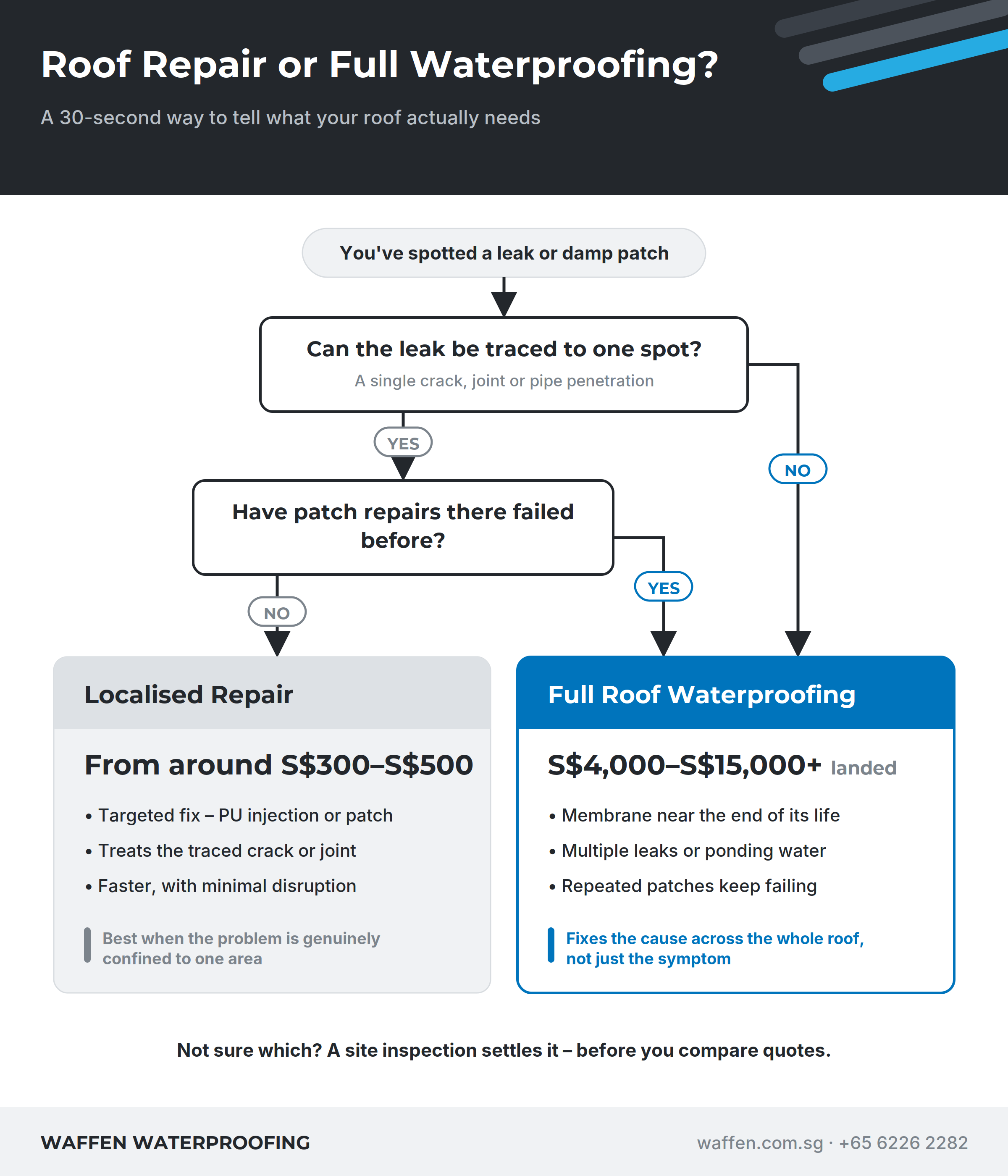
Roof Repair vs Full Waterproofing: Which Do You Need?
Not every leak requires the entire roof to be waterproofed again.
A localised repair may be appropriate when the problem can be clearly traced to a small crack, joint, penetration or damaged section.
Full or extensive waterproofing may be more appropriate when:
- The existing membrane has reached the end of its service life
- Multiple areas are leaking
- Waterproofing has deteriorated across a large area
- The substrate has widespread damage
- Previous patch repairs have repeatedly failed
- Water is ponding across the roof
- The existing waterproofing system is no longer reliable
A proper inspection can help determine whether a targeted repair or a more comprehensive solution makes financial and practical sense.
Questions to Ask a Roof Waterproofing Contractor
Before accepting a quotation, consider asking:
- What waterproofing system do you recommend and why?
The contractor should be able to explain why the proposed system suits your particular roof. - What preparation is included?
Ask whether cleaning, grinding, crack repairs, hacking and old membrane removal are included. - How will drains and joints be treated?
These areas require proper detailing rather than simply coating over them. - Is water testing included?
Testing can help verify the effectiveness of the completed waterproofing works. - What does the warranty cover?
Ask how long the warranty lasts and what conditions may invalidate it. - Who will carry out the work?
Understanding whether the work is performed by the contractor’s own team or subcontracted workers can also help you assess the project.
Final Thoughts
The average roof waterproofing cost in Singapore is best treated as a range rather than a single figure. As a starting point, professional waterproofing can cost around S$15–S$60 per square metre, while a complete landed-property project can run from several thousand dollars to S$15,000 or more depending on the scope.
The most important factor is not simply how much waterproofing costs per square metre, but what you are actually getting for the price.
A reliable waterproofing solution should address the underlying cause of water ingress, include appropriate surface preparation and use a system suited to the roof. Comparing quotations based on the complete scope of work, rather than price alone, can help you avoid repeated repairs and unnecessary costs.
If your roof is showing signs of leakage or deteriorating waterproofing, a professional site inspection is the best way to determine whether you need a localised repair or a complete waterproofing solution.
Looking for professional roof waterproofing in Singapore? Contact Waffen Waterproofing for an assessment and quotation tailored to your roof’s condition and requirements.

Sorry, the comment form is closed at this time.