

28 Aug Why Commercial Roofs Require Different Waterproofing Approaches
Short answer: Commercial roofs often have larger surface areas, more penetrations, heavier equipment, greater foot traffic and more complex drainage requirements than residential roofs.
Waterproofing therefore needs to be selected according to the roof structure, substrate, exposure, usage and maintenance requirements rather than relying on a one-size-fits-all coating.
Introduction
A commercial roof does more than keep rain out. It forms part of the building envelope and may need to protect offices, warehouses, equipment, stock and other valuable assets underneath it. When waterproofing fails, the resulting water ingress can disrupt operations as well as damage the building.
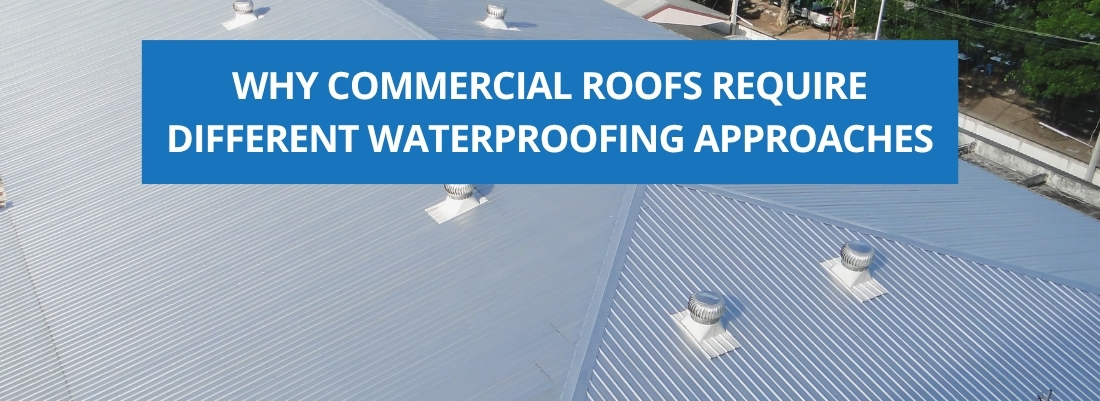
Commercial roofs also tend to have different requirements from residential roofs. A large flat roof may have air-conditioning equipment, pipe penetrations, drainage outlets, access walkways and other structures that create additional areas where water can enter.
In Singapore’s tropical climate, these considerations become even more important. High humidity and heavy rainfall make appropriate waterproofing design, material selection and installation essential for protecting buildings against water penetration. Singapore Standard SS 637:2018 provides recommendations for the design, selection and installation of waterproofing systems for reinforced concrete buildings in tropical conditions.
Why Commercial Roofs Face Different Waterproofing Challenges
Commercial roofs are often larger and more heavily used than residential roofs. Their waterproofing system therefore needs to account for more than simply keeping rainwater out.
Common challenges include:
- Large exposed roof areas
- Frequent exposure to sunlight and rain
- Air-conditioning and mechanical equipment
- Pipe and cable penetrations
- Drainage outlets and roof gutters
- Expansion and construction joints
- Maintenance and service access
- Occasional foot traffic
- Ponding water on low-slope or flat roofs
Each of these features can create potential weak points if the waterproofing system is not properly designed and installed.
Commercial Roofs Often Have More Penetrations
One of the biggest differences between a simple residential roof and a commercial roof is the number of services that may pass through or sit on the roof.
Commercial buildings commonly have:
- Air-conditioning systems
- Ventilation equipment
- Pipes
- Electrical conduits
- Cable trays
- Solar installations
- Exhaust systems
- Roof access structures
Every penetration creates a junction between different materials or surfaces. These areas require careful detailing because even a small gap or failed seal can become an entry point for water.
A waterproofing system therefore needs to account for these details rather than treating the roof as one uninterrupted surface.
Roof Size Changes The Waterproofing Strategy
The larger the roof, the more important the overall system design becomes.
A small roof may be relatively straightforward to inspect and repair. A large commercial roof, however, can contain multiple drainage points, joints, equipment areas and different substrate conditions.
This means waterproofing contractors need to consider:
Drainage
Flat and low-slope commercial roofs depend heavily on effective drainage. If water remains on the roof for extended periods, it can place additional demands on the waterproofing system.
Waffen notes that flat roofs require continuous protection because standing water can find its way through weak points in the waterproofing system.
Surface Condition
Existing commercial roofs may have deteriorated coatings, cracks, previous waterproofing layers or damaged concrete.
Before a new system is installed, the existing substrate needs to be assessed and prepared appropriately.
Movement
Large roofs can experience thermal expansion and contraction as surfaces heat up during the day and cool during rainfall or at night.
A waterproofing system needs sufficient flexibility and adhesion to accommodate movement without cracking or separating from the substrate.
Different Roof Materials Need Different Systems
There is no single waterproofing material that is ideal for every commercial roof.
The appropriate system depends on the roof’s substrate, geometry, exposure and intended use.
| Waterproofing approach | Common commercial application | Key consideration |
|---|---|---|
| Torch-on bituminous membrane | Large concrete roofs, industrial roofs and podium decks | Durable and suitable for large areas |
| Liquid-applied membrane | Complex roofs, penetrations and irregular surfaces | Seamless application around detailed areas |
| Thermoplastic membranes | Certain commercial roofing systems | Material compatibility and installation requirements |
| EPDM membranes | Suitable commercial roofing applications | Requires properly bonded joints and detailing |
| Polymer-modified bitumen | Roofs exposed to demanding conditions | Designed for durability and heat resistance |
Waffen’s commercial roof waterproofing solutions include modified bituminous membranes, thermoplastic membranes, EPDM and liquid-applied membrane systems, with the appropriate choice depending on the project requirements.
When Torch-On Waterproofing Makes Sense
Torch-on membrane waterproofing is commonly used for large roof areas because it creates a robust, bonded waterproofing layer.
The system uses bituminous membrane sheets that are heated and bonded to the substrate. Proper installation includes attention to overlaps, edges, corners, joints and other vulnerable areas.
Waffen identifies torch-on membrane systems as suitable for applications including RC flat roofs, roof terraces, podium decks, carpark roofs, industrial rooftops and warehouses.
For commercial projects, this approach can be useful where the roof requires a durable membrane system capable of handling demanding environmental conditions.
However, torch-on membranes require professional installation and careful preparation. The system must be compatible with the substrate and the surrounding roof details.
When Liquid-Applied Waterproofing Makes Sense
Liquid-applied waterproofing takes a different approach. Instead of laying sheets across the roof, the material is applied directly to the prepared surface and cured to form a continuous membrane.
This can be particularly useful where a commercial roof contains many corners, penetrations, irregular shapes or difficult-to-access areas.
Waffen describes liquid-applied systems as suitable for complex shapes, corners and areas with multiple penetrations because the cured membrane forms a continuous, joint-free barrier.
Liquid-applied systems can also be useful during renovation projects where completely removing the existing surface may not be practical, provided the existing substrate is suitable for the selected system.
Commercial Roofs Need More Attention To Detail
The main roof surface is only one part of a waterproofing system.
Many leaks originate around details such as:
- Roof edges
- Parapets
- Drainage outlets
- Pipe penetrations
- Expansion joints
- Equipment bases
- Corners
- Changes in roof level
These areas require careful preparation and detailing.
For example, a waterproofing membrane may perform well across a large flat surface but still fail if a pipe penetration is poorly sealed. This is why professional waterproofing involves more than simply applying a coating across the roof.
Waterproofing And Commercial Roof Usage
Another consideration is how the roof will be used.
Some commercial roofs are rarely accessed except for maintenance. Others may contain air-conditioning equipment, mechanical systems or service routes that require regular access.
If workers need to walk across the roof frequently, the waterproofing system may require additional protection against mechanical damage and foot traffic.
The waterproofing strategy should therefore consider not only exposure to rain but also what happens on the roof after installation.
Why Singapore’s Climate Matters
Commercial roofs in Singapore are exposed to a combination of heavy rainfall, high humidity and strong sunlight.
Singapore Standard SS 637:2018 specifically recognises the local climatic conditions of high relative humidity and heavy rainfall as important considerations when protecting building components against water seepage and rainwater penetration.
This makes material durability and installation quality particularly important.
A waterproofing system may be exposed to repeated wet-dry cycles and temperature changes throughout its service life. Poor surface preparation, inadequate detailing or unsuitable materials can reduce the system’s ability to perform under these conditions.
Why Surface Preparation Matters
Even a high-quality waterproofing material cannot perform properly if it is applied to an unsuitable surface.
A commercial roof may first require:
- Cleaning and removal of contaminants
- Inspection for cracks and damaged areas
- Repair of defects
- Drying and moisture assessment
- Priming where required
- Reinforcement of vulnerable details
- Application of the selected waterproofing system
- Final inspection and testing
Waffen’s liquid-applied waterproofing methodology similarly includes inspection, surface preparation, detail reinforcement, membrane application, curing and final quality checks.
Proper preparation helps the waterproofing system bond effectively and reduces the risk of premature failure.
Commercial Waterproofing Should Start With An Inspection
A recurring roof leak does not necessarily mean that the visible location is the actual source of the problem.
Water can travel through roof layers, cracks and building components before appearing inside the building. Simply sealing the area where water becomes visible may therefore provide only a temporary solution.
A professional inspection should consider:
- Where water is entering
- The condition of the existing waterproofing
- Cracks and surface defects
- Drainage performance
- Roof penetrations
- Previous repair work
- Moisture conditions
- The most suitable waterproofing system
Waffen states that its inspection process includes assessing leakage sources and surface conditions before recommending a waterproofing solution.
Commercial Roof Waterproofing Is A Long-Term Decision
For a commercial property, waterproofing should not be treated as a quick cosmetic repair.
A roof leak can lead to:
- Damage to ceilings and internal finishes
- Dampness and staining
- Deterioration of building materials
- Disruption to business operations
- Damage to equipment or stored goods
- Repeated repair costs
Selecting a suitable waterproofing system at the beginning can help reduce the likelihood of recurring problems.
It is also important to consider future maintenance. A system should be selected with the building’s access requirements, roof usage and expected maintenance needs in mind.
How To Choose A Commercial Roof Waterproofing Approach
Before selecting a system, property owners and facility managers should consider several questions.
What Is The Roof Made Of?
Concrete, metal and other roofing substrates can require different waterproofing approaches and preparation methods.
Is The Roof Flat Or Pitched?
Flat and low-slope roofs generally have greater dependence on drainage, while pitched roofs rely more heavily on their slope and detailing.
How Much Equipment Is On The Roof?
Multiple penetrations and equipment bases can make liquid-applied systems particularly useful in certain applications, although the final choice should be based on the actual site conditions.
Is The Roof Frequently Accessed?
If maintenance workers regularly access the roof, the waterproofing system may need additional protection against mechanical wear.
Is There Existing Waterproofing?
The condition and compatibility of existing layers should be assessed before deciding whether to repair, overcoat or replace the system.
Final Thoughts
Commercial roofs require a different approach to waterproofing because they often combine large surface areas with complex drainage, equipment, penetrations, joints and maintenance requirements.
The right solution depends on the roof structure, substrate, exposure and intended use. Torch-on membranes can provide a durable solution for many large commercial and industrial roof applications, while liquid-applied systems can be particularly useful around complex geometries and numerous penetrations.
Most importantly, waterproofing should begin with a proper assessment rather than simply applying a product to the visible area of a leak. Careful surface preparation, correct detailing and appropriate material selection are all important to achieving long-term protection.
Contact Waffen Waterproofing
Whether you need a full roof waterproofing system or targeted repairs, Waffen Waterproofing is here to help.
We provide tailored waterproofing solutions for residential and commercial properties across Singapore, from liquid-applied systems to torch-on membranes. Contact us today to arrange an on-site assessment and find the right solution for your property.

Sorry, the comment form is closed at this time.