

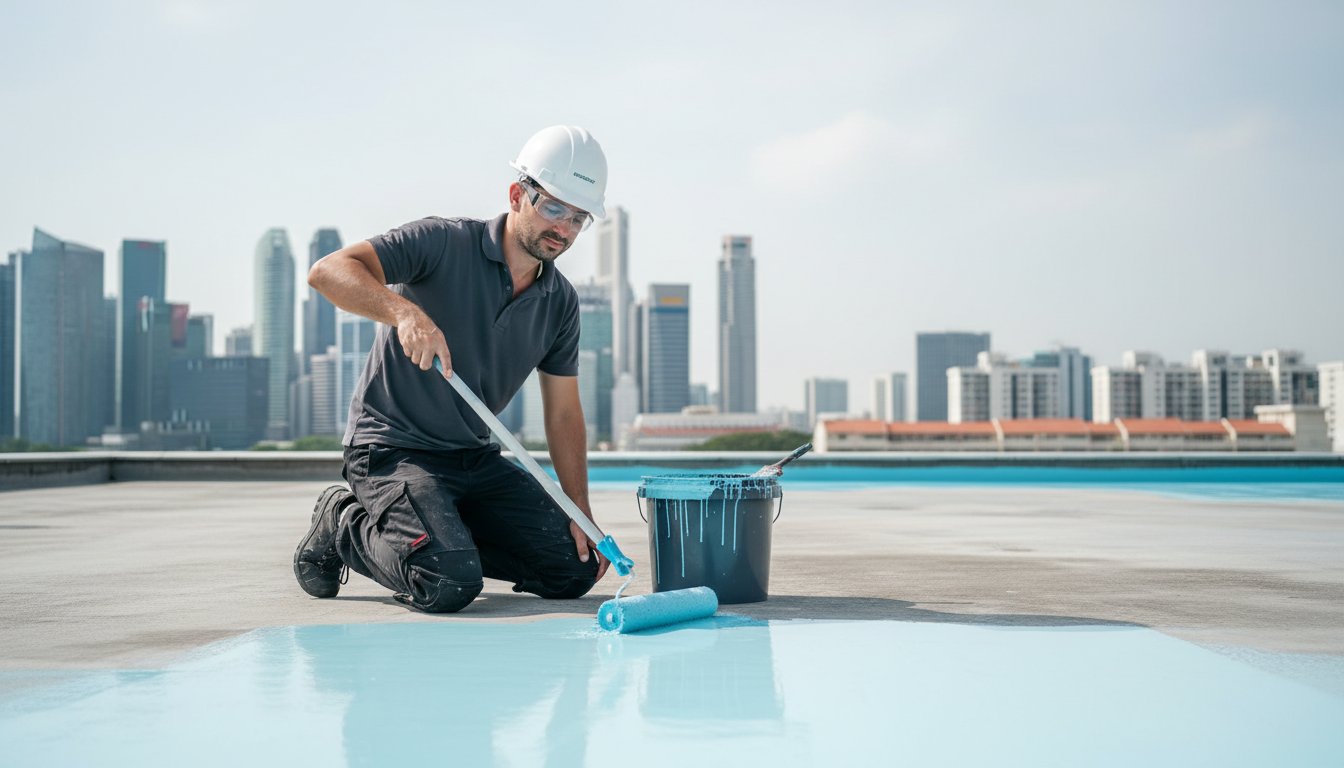
24 Apr Roof Waterproofing Services in Singapore: The Complete 2026 Homeowner’s Guide
Last November, a homeowner in Bukit Timah watched S$12,000 worth of designer teak flooring warp after a single monsoon downpour bypassed a budget patch repair. You’ve likely experienced the same dread when a recurring ceiling stain reappears despite paying for multiple quick fixes. It’s a serious responsibility to maintain structural integrity, yet many owners find themselves trapped in a cycle of failed repairs that threaten their interior investments. You deserve a permanent solution that respects your time and your property’s value.
This 2026 guide empowers you with the technical knowledge to select the right roof waterproofing services, ensuring your property remains protected by advanced diagnostic sensors and high-performance membranes. We’ll detail the latest BCA-approved systems and transparent warranty structures that eliminate the fear of hidden costs. You’ll learn how to identify the root cause of seepage and implement a disciplined, leak-free strategy without the high expense of traditional floor hacking.
Key Takeaways
- Understand why Singapore’s extreme UV index and heavy monsoon rainfall require a multi-layered structural protection system to prevent long-term property damage.
- Compare advanced roof waterproofing services, such as Liquid-Applied Membranes (LAM), to determine the most flexible and durable solution for complex roof geometries.
- Discover how professional contractors use non-invasive, data-driven diagnostic technologies to pinpoint leaks precisely without the need for costly and disruptive hacking.
- Learn how to verify essential credentials, including BCA registration and HDB licenses, to ensure your specialist meets Singapore’s rigorous regulatory and safety standards.
- Find out how to secure a permanent solution using BCA-grade materials and take advantage of a “Same Day Free Onsite Inspection” for immediate peace of mind.
Why Professional Roof Waterproofing Services are Critical in Singapore
Professional roof waterproofing services involve much more than applying a basic coat of liquid sealant. It’s a sophisticated, multi-layered structural protection system designed to isolate a building’s internal skeleton from liquid ingress. To understand the technical scope of these systems, one might ask, What is waterproofing? In a professional context, it’s the integration of surface preparation, specialized primers, high-performance membranes, and UV-resistant topcoats that work together to ensure a watertight seal.
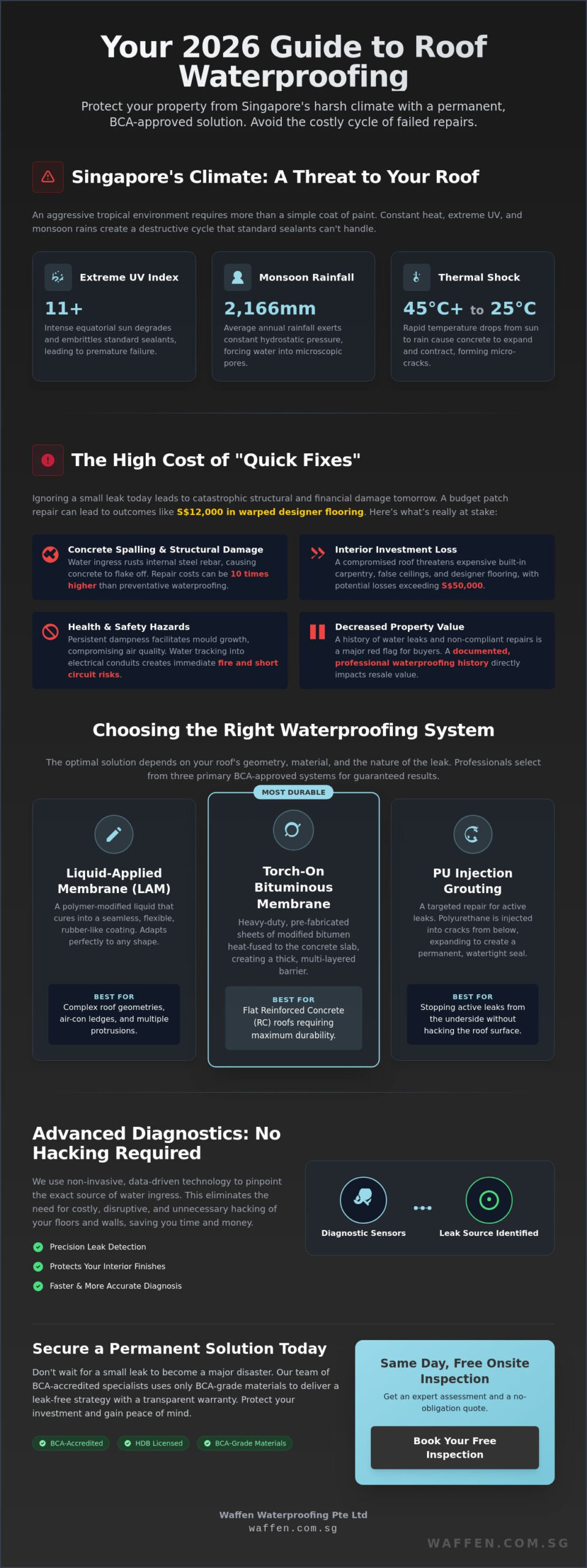
Singapore’s tropical environment is uniquely aggressive toward building materials. With an average annual rainfall of 2,166mm and a UV index that frequently hits extreme levels above 11, rooftops face constant degradation. The intense heat causes concrete roof slabs to reach temperatures exceeding 45°C during the day. When a sudden monsoon downpour occurs, the temperature drops rapidly. This cycle of thermal expansion and contraction leads to micro-cracks in the concrete. These fissures allow moisture to bypass the surface, leading to structural weakening over time.
Ignoring minor seepage leads to significant hidden costs. Water ingress triggers the carbonation process in reinforced concrete, causing the internal steel rebar to rust and expand. This pressure forces the concrete to flake off, a condition known as spalling. Once this stage is reached, the repair costs can be ten times higher than a standard maintenance job. Additionally, persistent dampness facilitates mould growth, which compromises indoor air quality and poses health risks to residents.
The Role of Roof Integrity in Property Value
Maintaining a documented history of roof waterproofing services directly impacts the resale value of landed properties in Singapore. Savvy buyers and surveyors look for BCA-standard compliance before finalizing a purchase. Beyond the structural frame, a compromised roof threatens S$50,000 built-in carpentry installations and expensive false ceilings. More critically, water tracking into electrical conduits creates immediate safety hazards, potentially causing short circuits or fire risks in the home.
Singapore Weather vs. Standard Sealants
Off-the-shelf hardware store sealants typically fail within one dry-wet cycle in Singapore’s climate. These DIY products lack the necessary elongation properties to bridge moving cracks during thermal shifts. Reliable systems prioritize UV-resistant topcoats to prevent the underlying membrane from becoming brittle under the equatorial sun. Hydrostatic pressure in the context of flat roofs is the gravitational force exerted by ponding water that drives moisture into the substrate through microscopic pores. Without professional-grade materials, this pressure eventually forces water through the slab, regardless of how many layers of standard paint are applied. Property owners searching for roof repairing near me Singapore will find that understanding these material limitations is the first step toward selecting a solution that genuinely lasts beyond a single monsoon season.
Comparing Top Roof Waterproofing Systems: Membranes and Injections
Singapore’s tropical climate, characterized by annual rainfall exceeding 2,300mm and high humidity levels, places immense stress on building structures. To combat water ingress, professional roof waterproofing services focus on three primary systems: Liquid-Applied Membranes (LAM), Torch-On Bituminous Membranes, and Polyurethane (PU) Injection Grouting. Selecting the right system depends on the roof’s geometry, the substrate material, and the severity of existing leaks.
- Liquid-Applied Membranes (LAM): These systems use polymer-modified bitumen or polyurethane liquids that cure into a seamless, rubber-like coating. They’re highly effective for roofs with complex shapes, air-con ledges, and numerous protrusions.
- Torch-On Bituminous Membranes: This heavy-duty solution involves pre-fabricated sheets of bitumen modified with APP (Atactic Polypropylene) or SBS (Styrene Butadiene Styrene). Contractors use a torch to fuse the membrane to the concrete slab, creating a thick, multi-layered barrier.
- PU Injection Grouting: Often called “pressure grouting,” this is a targeted repair method for active leaks. It addresses cracks from the underside of the slab without requiring any hacking of the roof surface.
Liquid-Applied vs. Torch-On: Which is Better?
Durability and substrate compatibility are the main deciders here. Torch-on membranes are the industry standard for flat Reinforced Concrete (RC) roofs due to their 3mm to 4mm thickness and superior puncture resistance. A well-installed torch-on system typically lasts 10 to 15 years. In contrast, LAM systems are thinner and usually offer a service life of 5 to 7 years before a maintenance coat is required. However, LAM is much faster to apply in Singapore’s unpredictable weather, as it doesn’t require open flames and can adhere to metal, tiles, or concrete. Adherence to standards is vital; following BCA’s Good Industry Practices ensures that surface preparation and curing times are managed correctly to prevent debonding in high-humidity environments.
When to Use Polyurethane (PU) Injection
PU injection is the preferred “no-hacking” solution for HDB and condo owners facing localized dripping. When a specialist injects the PU resin into a crack, it reacts with moisture and expands up to 10 times its volume. This expansion creates a dense, closed-cell foam that seals the leak path instantly. It’s a non-invasive process that usually takes less than 4 hours to complete, making it highly efficient for urgent repairs.
While injection is excellent for stopping active leaks in specific spots, it’s a reactive measure. If the concrete slab has widespread porosity or the existing external membrane has reached the end of its lifespan, a full membrane replacement is necessary. For a professional assessment of your roof’s condition, you can request a free onsite inspection to determine if injection or a full membrane system is the most cost-effective path forward.
Advanced Diagnostics: Identifying Leaks Without Hacking
The traditional approach to leak detection often involved significant guesswork, leading to the unnecessary hacking of tiles and concrete. Today, professional roof waterproofing services have shifted toward a data-driven diagnostic model. This transition saves Singaporean homeowners thousands of dollars by avoiding destructive testing. To see how similar technological innovation and AI-enabled product development are being applied across various sectors, check out Northbound Software Studio. Instead of tearing up a functional roof, specialists use non-destructive testing (NDT) to identify the precise origin of a leak. A comprehensive onsite diagnostic report provides a clear roadmap for targeted repairs, ensuring that every cent of your maintenance budget is used effectively.
Many property owners question the need for an inspection when a leak is clearly visible. However, water is deceptive. It can enter through a hairline crack on one side of a building and travel 10 meters along a structural beam before dripping into a living room. Relying on visual cues alone leads to patchwork fixes that fail during the next monsoon season. A disciplined diagnostic process removes this risk, providing the peace of mind that comes with a permanent solution rather than a temporary bandage. This methodical approach is why engaging qualified roof leakage repairs specialist contractors is essential for maintaining structural integrity.
Thermal Imaging and Infrared Thermography
Infrared thermography is a cornerstone of modern NDT for Singapore’s high-rise buildings and landed properties. This technology allows technicians to detect anomalies in heat signatures without disturbing the building facade. Thermal cameras “see” moisture through concrete by identifying the distinct temperature differences between dry structural elements and water-saturated pockets. This method is particularly effective for identifying trapped water beneath a torch-on membrane or within a reinforced concrete slab, allowing for surgical intervention rather than total replacement.
Electronic Moisture Meters and Flood Testing
Quantitative data is essential for a reliable repair. Electronic moisture meters measure the exact percentage of saturation within a substrate, helping contractors determine if a slab is dry enough for a new coating. For new installations, the 24-hour flood test remains the gold standard for verification. This involves plugging drains and submerging the roof area under a controlled depth of water to ensure the membrane is 100% watertight. When leaks are suspected to originate from internal plumbing, acoustic leak detection is employed to listen for the specific frequency of pressurized water escaping from hidden pipes. These rigorous standards ensure that every roof waterproofing services project meets BCA and HDB requirements for safety and performance.
Choosing a BCA-Accredited Waterproofing Contractor in Singapore
Selecting a specialist for roof waterproofing services requires more than just comparing quotes. In Singapore, the Building and Construction Authority (BCA) maintains a registry of contractors who meet specific financial, technical, and management criteria. Hiring a BCA-registered firm ensures you’re engaging a legitimate entity with the proven capacity to handle structural repairs. For residential owners dealing with inter-floor leaks, verifying an HDB license is equally critical. This license confirms the contractor understands the strict guidelines for flat-to-flat repairs, preventing legal disputes with neighbors or the housing board.
Evaluating Contractor Credibility
A professional quotation is the first test of credibility. Be wary of contractors who provide verbal estimates or vague one-page receipts. A reliable service agreement must detail the scope of work, material specifications, and the exact method of application. You should also examine their portfolio to ensure they have experience relevant to your property type. Industrial roof repairs require different technical skills than residential balcony waterproofing. “Ghost” warranties are a common industry pitfall; these are promises that disappear when the company closes and reopens under a new name. Always check that the warranty is a legally binding document issued by an established firm with a physical office in Singapore. For a comprehensive overview of what to look for when hiring, our guide on roof leakage repairs specialist contractors in Singapore covers the exact certifications and red flags every property owner should know.
Safety and Compliance Standards
Roof work is high-risk. The Workplace Safety and Health (WSH) Act mandates strict safety protocols for all onsite activities. You must verify a contractor’s bizSAFE level; bizSAFE Level 3 or higher indicates the company has conducted thorough risk assessments and established a robust safety management system. For high-rise external wall repairs, ensure the team holds IRATA rope access certifications. This global standard ensures technicians can safely navigate vertical surfaces without compromising themselves or the public. Public liability insurance is a non-negotiable requirement. This coverage protects you from financial responsibility if property damage or personal injury occurs during the project.
A “Reliable 12-Month Warranty” provides the peace of mind every property owner needs. This coverage typically accounts for both workmanship defects and material failure. If a leak recurs within the 12-month period due to an application error, a disciplined contractor will rectify the issue at no additional cost. This timeframe is essential because it allows the waterproofing system to be tested through a full cycle of Singapore’s monsoon seasons. It’s a hallmark of a specialist who stands by their technical excellence. Homeowners who have already begun researching roof repairing near me Singapore will recognize that BCA SS 637: 2018 compliance and a verifiable warranty structure are the clearest indicators of a contractor who delivers lasting results.
Contact our team today for a Same Day Free Onsite Inspection to secure your property against water damage.
Waffen Waterproofing: Your Trusted Specialist for Permanent Solutions
Choosing a provider for roof waterproofing services requires more than just a quick fix. Waffen Waterproofing Pte Ltd operates with a sense of serious responsibility, knowing that structural integrity is non-negotiable for Singaporean property owners. Our approach integrates BCA-grade materials with advanced technical diagnostics to deliver permanent results. We don’t rely on guesswork. Instead, we use precision tools to identify the exact source of water ingress. For residents facing urgent leaks, our Same Day Free Onsite Inspection promise provides immediate relief and a clear path forward. Every project is handled by qualified technicians who adhere to a Safety First mentality. This means we prioritize site safety and rigorous training, ensuring that work is completed without incident or compromise. Our status as a reliable waterproofing specialist is built on a decade of delivering consistent, high-standard results across residential and commercial properties.
Our Proven Waterproofing Process
We follow a methodical, three-step system to ensure every roof waterproofing services project meets our high standards of excellence. This structured flow ensures no detail is overlooked during the repair or installation phase.
- Step 1: Technical diagnostic inspection and moisture mapping. Our experts use thermal imaging and moisture meters to create a detailed map of your roof’s condition. This identifies trapped moisture and structural weak points that are invisible to the naked eye.
- Step 2: Surface preparation and high-quality membrane application. We prepare the substrate to ensure maximum adhesion, removing old debris and repairing cracks. Depending on your roof type, we apply specialized solutions such as torch-on membranes or high-performance liquid coatings that withstand Singapore’s intense heat and heavy rainfall.
- Step 3: Final quality check and warranty issuance. After the application cures, we conduct a rigorous inspection to verify the seal’s integrity. Once our lead technician signs off, we issue a 12-month service warranty, providing you with documented security and peace of mind.
Contact Waffen for a Leak-Free Property
Proactive maintenance is the most effective way to avoid the heavy costs of emergency repairs. A small damp patch can quickly evolve into a major structural failure if ignored. Our team brings a decade of experience and bizSAFE accreditation to every job site. We’ve earned our reputation through disciplined work and transparent communication. Don’t let a minor leak become a S$10,000 restoration project. You can book your inspection via WhatsApp or phone today for a professional assessment. Our specialists are ready to provide the technical expertise required to protect your investment for the long term.
Protect Your Home with Expert Roof Waterproofing
Securing your property against Singapore’s heavy tropical downpours requires more than a temporary fix. It demands a systematic approach using advanced moisture detection technology to identify leaks without the need for destructive hacking. By choosing a BCA-accredited and HDB-licensed specialist, you ensure that your roof waterproofing services adhere to the strictest safety and quality standards. This disciplined methodology prevents minor seepage from escalating into costly structural damage. Waffen Waterproofing provides the technical expertise and precision needed to maintain your building’s integrity through 2026 and beyond.
Book a Same-Day Free Onsite Inspection with Waffen Waterproofing Specialist
Your home deserves the protection of a reliable professional who prioritizes technical excellence and transparency.
Frequently Asked Questions
How much do roof waterproofing services cost in Singapore?
Roof waterproofing services costs in Singapore depend on the specific application method and the total surface area. According to 2024 industry data, basic liquid membrane applications typically range from S$15 to S$45 per square meter. More complex systems like torch-on membranes or specialized PU injection for concrete roofs involve different pricing structures. We provide a Same Day Free Onsite Inspection to give property owners a transparent, fixed-price quote based on their specific structural needs.
How long does a typical roof waterproofing project take?
A standard roof waterproofing project for a residential property usually takes 3 to 7 working days to complete. The timeline varies based on the roof’s size and the weather conditions during the application. For instance, a 100 square meter flat roof requires sufficient time for each chemical layer to cure properly. Our BCA accredited technicians monitor humidity levels closely to ensure the installation meets high quality standards without unnecessary delays.
Is it possible to waterproof a roof without hacking existing tiles?
Yes, it’s possible to waterproof a roof without hacking existing tiles by using advanced clear penetrative sealants or high-performance liquid membranes. These non-invasive roof waterproofing services allow us to seal leaks without creating dust, noise, or heavy debris. This method is highly effective for tiled roofs where the tiles are still structurally sound. It’s a faster, cleaner alternative that utilizes PU injection or flood infusion to stop seepage at the source.
What is the difference between HDB ceiling leaks and private roof leaks?
The main difference involves legal responsibility and the structural repair framework. For HDB ceiling leaks, the Town Council and the upper floor neighbor typically split the repair costs under a 50/50 co-payment scheme. In private properties, the owner is fully responsible for the entire roof and facade maintenance. Private roofs also feature diverse materials like clay tiles or metal sheets, whereas HDB blocks mostly use reinforced concrete flat roofs requiring industrial-grade membranes.
How often should I have my roof inspected for potential seepage?
You should schedule a professional roof inspection at least once every 12 months to detect early signs of membrane failure. Singapore’s intense UV exposure and heavy monsoon rains cause materials to expand and contract, leading to hairline cracks. A Reliable Waterproofing Specialist can identify these issues before they escalate into expensive structural damage. Regular checks ensure your property remains BCA compliant and helps extend the overall lifespan of your existing waterproofing system.
Does home insurance cover roof waterproofing and leak repairs?
Most standard home insurance policies in Singapore cover damage to internal contents caused by sudden pipe bursts but exclude repairs for gradual wear and tear. If a leak results from a lack of maintenance, the insurer will likely deny the claim. However, some premium plans might cover the cost of repairing the actual leak source if it’s deemed a latent defect. It’s vital to review your policy for terms like “gradual deterioration” before starting repairs.
Can I stay in my house during the waterproofing process?
Residents can stay in their homes during the entire process because we use non-toxic, low-odor materials for our roof waterproofing services. Our team operates with a safety first mentality, ensuring the work zone is contained and doesn’t interfere with your daily routine. While some noise occurs during surface preparation, it’s generally manageable for occupants. We follow bizsafe level 3 protocols to maintain a secure environment for your family throughout the project duration.
What is the standard warranty period for professional waterproofing in SG?
The standard warranty period for professional waterproofing in Singapore is 12 months for workmanship and materials. Some specialized industrial systems can offer extended coverage reaching up to 5 or 10 years depending on the product used. As a qualified Waterproofing Specialist, we issue a formal certificate of warranty upon completion of every project. This document guarantees that any recurring seepage issues within the timeframe are addressed promptly at no additional cost to the owner.

Sorry, the comment form is closed at this time.